Erasmus Greek New Testament (Novum Instrumentum)
Desiderius Erasmus published the first commercially printed Greek New Testament in Basel, providing the textual rocket fuel for the Protestant Reformation.
What Texts and Translations Did This Version Use?
The foundational manuscripts, earlier translations, and polyglots consulted during compilation.
Who In The Future Used This Translation?
Modern revisions, authorized successors, and descendants shaped by this text.
Tyndale New Testament & Pentateuch
William Tyndale used Erasmus's 3rd edition (1522) Greek New Testament as his primary text for translating the English New Testament.
Luther German Bible
Martin Luther translated the September Testament at Wartburg Castle directly from Erasmus's 1519 Greek edition.
King James Version (Authorized Version)
The KJV New Testament was translated from the Textus Receptus editions of Robert Stephanus (1550) and Theodore Beza (1598), direct descendants of Erasmus's Greek NT.
Translators & Committees
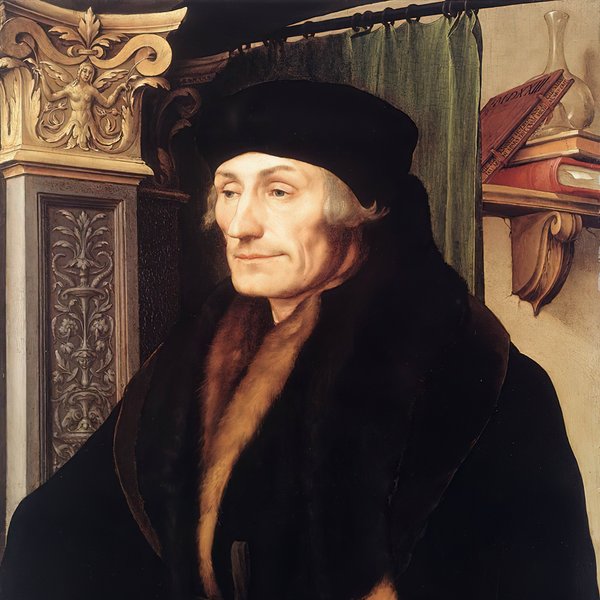
Desiderius Erasmus of Rotterdam
Prince of the Humanists & Renaissance Scholar
1466 – 1536 • Dutch
"I would that the farmer sing parts of the scriptures at the plow, that the weaver hum them to the tune of his shuttle, that the traveler beguile with their stories the weariness of his journey."
Desiderius Erasmus of Rotterdam was a Dutch philosopher and Christian humanist widely considered one of the greatest scholars of the northern Renaissance. Using humanist textual critique, Erasmus produced the first commercially published Greek New Testament, Novum Instrumentum omne, in Basel in 1516. His parallel Greek and Latin edition exposed numerous translation inaccuracies in the centuries-old Latin Vulgate (such as proving that Greek metanoite meant "repent" or "change your mind", not "do penance"). His Greek text established the foundation for the Textus Receptus, fueling vernacular translations across Reformation Europe.
Read full biographyHistorical Context & Textual Significance
Formed the foundation of the "Textus Receptus" (Received Text), the Greek basis for Luther’s German Bible, Tyndale’s English Bible, the Geneva Bible, and the King James Version.
Where Can You View Original Surviving Copies Today?
Known physical copies preserved in world archives and library vaults.