Tyndale New Testament & Pentateuch
The bedrock of the English Bible: the first English translation printed directly from the original Greek and Hebrew.
What Texts and Translations Did This Version Use?
The foundational manuscripts, earlier translations, and polyglots consulted during compilation.
Erasmus Greek New Testament (Novum Instrumentum)
William Tyndale used Erasmus's 3rd edition (1522) Greek New Testament as his primary text for translating the English New Testament.
Bomberg Second Rabbinic Bible (Mikraot Gedolot)
Tyndale translated the Hebrew Old Testament (Pentateuch & Jonah) directly from the Bomberg Rabbinic Bible printed in Venice.
Who In The Future Used This Translation?
Modern revisions, authorized successors, and descendants shaped by this text.
Coverdale Bible
Coverdale adopted Tyndale's New Testament and Pentateuch almost verbatim, translating the remainder from German and Latin.
Matthew Bible
John Rogers incorporated Tyndale's published work plus Tyndale's unpublished manuscripts for Joshua through 2 Chronicles.
Geneva Bible
The Marian exiles in Geneva thoroughly revised Tyndale's foundational English wording against fresh Hebrew and Greek texts.
King James Version (Authorized Version)
Computer textual analysis demonstrates that approximately 84% of the King James New Testament and 76% of the Old Testament is William Tyndale's phrasing word-for-word.
Translators & Committees
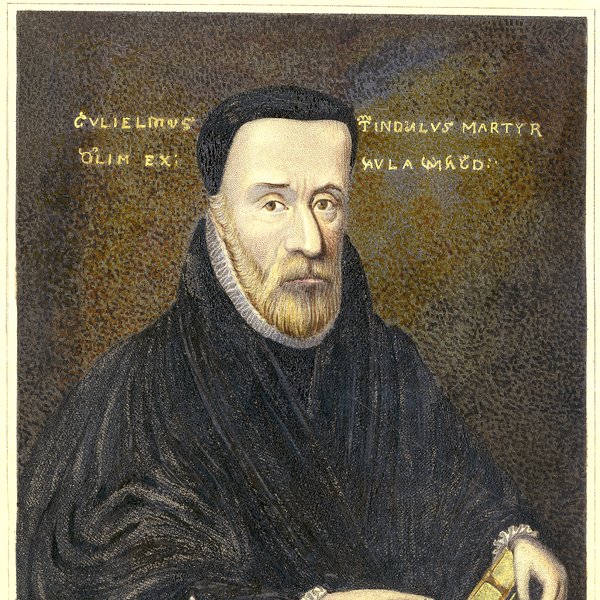
William Tyndale
Father of the English Bible & Protestant Reformer
1494 – 1536 • English
"If God spare my life, ere many years I will cause a boy that driveth the plough shall know more of the scripture than thou dost."
William Tyndale was an English biblical scholar and linguist who became a leading figure in the Protestant Reformation. Educated at Magdalen Hall, Oxford, and Cambridge, Tyndale became convinced that the English people urgently needed scripture in their native language directly translated from the original biblical tongues—Greek and Hebrew—rather than translated from Jerome's Latin Vulgate. Finding no patron in England due to Bishop Tunstall's opposition, Tyndale fled to the Continent in 1524. In 1526 in Worms, Germany, he published the first printed English New Testament. Over the subsequent decade, he translated the Pentateuch, Jonah, and historical books while constantly staying ahead of agents of King Henry VIII and Sir Thomas More. Tyndale's magnificent gift of phrase established the rhythm, cadence, and vocabulary of modern English.
Read full biographyHistorical Context & Textual Significance
Gifted English literature with enduring idioms ("let there be light", "the powers that be", "fight the good fight", "am I my brother's keeper", "a sign of the times"). Approximately 84% of the King James New Testament is Tyndale word-for-word.
Where Can You View Original Surviving Copies Today?
Known physical copies preserved in world archives and library vaults.